
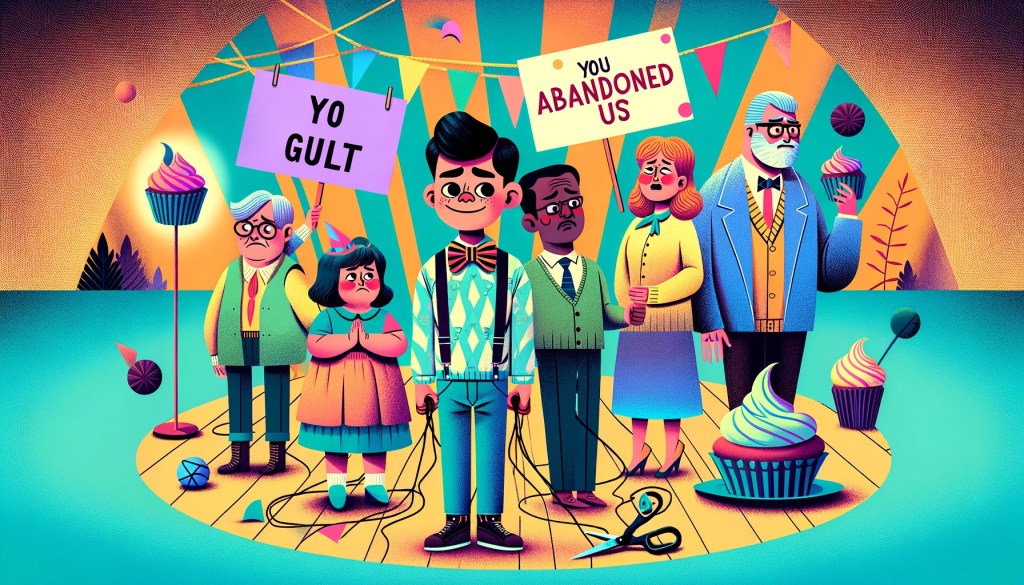
Welcome to the circus of human emotions! Today’s main attraction: Guilt! Step right up, ladies and gentlemen, as we unravel how this sneaky little emotion can be used to twist and turn people like marionettes on a string. Grab your popcorn, sit back, and enjoy the show!
Act 1: The Birth of Guilt
Every child enters this world a blank slate, free from guilt. Picture a newborn baby: pure, innocent, without a care in the world. Guilt is not one of those inborn emotions, like hunger or the urge to wiggle their tiny toes. Oh no, guilt is a social emotion. It’s something we learn from the moment we start interacting with our surroundings.
Imagine a toddler who has just colored the living room walls in crayon Picasso style. Enter stage left: the stern parent, the disappointed teacher, the judgmental sibling. “Bad baby, bad!” And thus, guilt is born, firmly implanted by society and cultural norms. It’s like a software update, and once installed, it becomes part of our emotional operating system.
Act 2: From God to Grandma: The Guilt Gurus
Now, let’s talk about how guilt is wielded like a marionette’s strings. Religions, cults, and political parties are the maestros of this art form. They know exactly how to pull the strings to make us dance to their tune.
Example 1: The Punishing God
Imagine you’ve just eaten the last cookie in the jar. Suddenly, you remember the all-seeing, all-knowing deity who disapproves of your gluttony. The image of a punishing God looms large, inducing guilt for your minor indiscretion. This divine guilt trip keeps you in line, ensuring you follow the rules, lest you face eternal damnation.
But wait, is this guilt-induced control a good thing? Some argue that without these guilt tactics, society would descend into chaos, with crime rates skyrocketing and everyone turning into mini-Hitlers (the famous atheist, remember?). But here’s the kicker: fearing divine punishment or the absence of a divine punishment doesn’t make you morally superior. Both types are like two sides of a rotten coin 🪙 . What we need isn’t guilt, but education to cultivate truly civilized human beings. But do we have enough courage to learn?
Example 2: Family Politics
Ever noticed those picture-perfect families where everything seems harmonious? Sometimes, this harmony is maintained through an unspoken hierarchy. Parents use guilt to mold their children into their own replicas. Questioning this hierarchy brings on a tsunami of guilt, keeping everyone in check. A person in such a ‘happy family’ derives happiness from pleasing other family members, not by being who he or she is truly. It’s like a guilt-powered force field, maintaining peace at the cost of individuality and true happiness. Picture this: your mom, in her best melodramatic tone, saying, “After everything I’ve done for you, this is how you repay me?” Or your sibling pulling the classic guilt trip with, “If you don’t help out more, you’re just adding to Mom and Dad’s stress.” These lines aren’t just expressions of disappointment—they’re masterful guilt-inducing maneuvers that would make a con artist proud.
Emotional blackmail is like a puppet show where guilt pulls the strings. It leverages guilt to control behavior, creating a delightful toxic stew where you feel compelled to act against your own interests just to avoid being the bad guy. This manipulation is like a termite infestation, slowly eating away at relationships, fostering resentment, and undermining genuine connections. Some folks still argue that setting boundaries will spoil family connections. But, let me tell you, it’s quite the opposite! Establishing these healthy boundaries makes relationships more genuine and prepares everyone to deal with the real world. Parents should beam with pride when their children speak up, even if it goes against traditional values. If the parents don’t get on board, then children need to be brave enough to let go and move forward, carrying these lessons into the next generation. After all, it’s about creating a legacy of honest, respectful relationships.

Example 3: Romantic Relationships
And now, the pièce de résistance: romantic relationships. Here, guilt is often disguised as love. One partner might impose irrational demands on the other, using guilt as their weapon of choice. “If you really loved me, you would…”, “If you don’t love me, I’ll kill myself”, “It’s your fault we are always fighting. If you were different, we’d be happy” are some conversations which are just a tip of the iceberg. This tactic has been romanticized through centuries of poems, novels, and movies. But let’s be honest, folks, it’s not love. It’s manipulation, pure and simple.
Act 3: Cutting the Strings
So, how do we break free from these guilt-induced chains? Here are a few practical solutions:
Set Healthy Boundaries: Understand that relationships, whether familial, romantic, or societal, should be built on respect and mutual understanding. Boundaries are not walls; they are guidelines for healthy interactions.
Earned Relationships: Titles like “father, 🧑 ” “mother 🧑 “, “partner 👩 “, “teacher 👩🏫 “, “friend 👧 ” and others should be earned through good behavior, not just granted by default. Respect should be mutual and deserved.
Self-Awareness: Recognize when guilt is being used against you. Question it. Is it justified, or is it a tool for manipulation?
Communication: Open, honest communication can dismantle guilt-traps. Express your feelings and concerns without fear of retribution.
Education: Cultivate a strong moral compass through education, not fear. Understanding right from wrong through learning and empathy creates a more stable foundation for ethical behavior.
Finale: The Exit
Guilt should be eradicated entirely, like how we eradicated smallpox. And I believe that the world will be a better place then. Guilt is always used as a tool for manipulation, it’s time to cut those strings and reclaim your autonomy. Remember, folks, life is too short to be a puppet in someone else’s play. Take charge, live guilt-free, and be the star of your own show! So, next time your brother tries to guilt you for going abroad to study with, “You abandoned us while we needed you here!” you’ll be ready to grin and reply, “Well, I guess I can always send postcards from my guilt-free zone!”
 The Online Thoughts
Nice piece of online thoughts! Read and guilt free!
LikeLike